
Selling
Ontario probate and estate administration tax, explained for home sales
What probate is, when a house sale needs it, how Ontario's estate administration tax is calculated, and how to plan the sale around the timing.

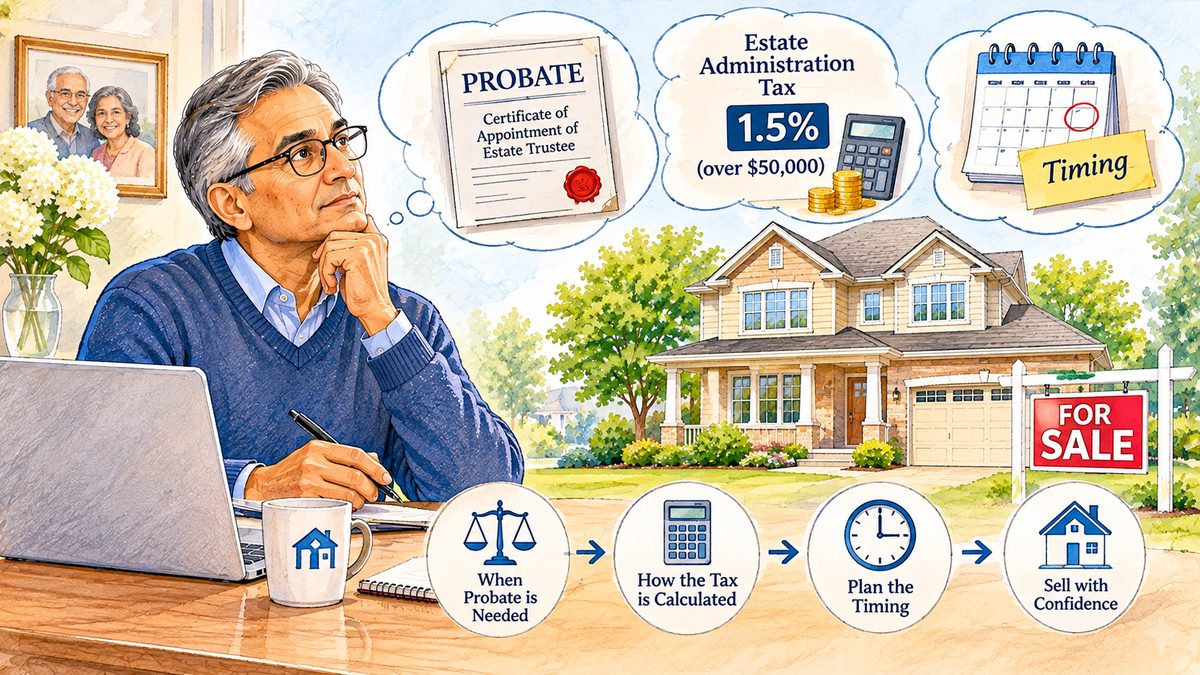
"Probate" is the word most executors hear first and understand least. In Ontario it means getting a Certificate of Appointment of Estate Trustee from the Superior Court of Justice. The certificate confirms the will is valid and that you have the authority to deal with the estate's assets, including selling a home.
This is general information, not legal or tax advice. Every estate is different. Your estate lawyer and accountant should confirm what applies to yours.
When a home sale needs probate
- Home in the deceased's sole name: probate is usually required before the sale can close, because the buyer's lawyer and the land registry need proof of your authority to transfer the title.
- Home owned jointly with someone else (as joint tenants): it usually passes to the surviving owner outside the estate, without probate.
- No will: someone must apply to be appointed estate trustee before the home can be sold.
How long it takes, and how to plan around it
Court processing times vary, and the application itself takes time to prepare, so many estates should expect it to take months rather than weeks. Your lawyer can give you a realistic estimate. You don't have to wait for the certificate to start: you can prepare the home, and often list it and accept an offer, with a closing date set comfortably after the expected grant. The agreement should make clear that the seller is an estate trustee, and your lawyer will want to review it before you sign.
Estate administration tax
Ontario charges estate administration tax on the value of the estate that passes through probate. As of 2026:
- No tax on the first $50,000 of the estate's value
- $15 for every $1,000 (1.5%) above $50,000
For example, an estate whose only probated asset is a home worth $1,000,000 would owe about $14,250: 1.5% of the $950,000 above the first $50,000. A mortgage registered on the home is generally deducted from its value for this calculation. Assets that pass outside the estate, such as a jointly owned home or accounts with a named beneficiary, aren't included.
The estate trustee must also file an Estate Information Return with the Ministry of Finance after the certificate is issued, listing the estate's assets and their values on the date of death. That is one reason a written date-of-death valuation for the home matters. We prepare these.
Small estates
Ontario has a simplified small estate procedure for estates worth $150,000 or less. Because almost any home in the GTA is worth more than that, it rarely applies when there is a house to sell.
Frequently asked questions
Can I list a house before probate is granted?
Often, yes. Preparing and listing the home while the application is processed saves time. The closing date has to fall after the certificate is expected, and your lawyer should review the agreement.
How much is probate on a house in Ontario?
Estate administration tax is 1.5% of the estate's value above $50,000, with nothing owed on the first $50,000. On an estate of $1,000,000 that is about $14,250. Legal fees for the application are separate.
Planning the sale around probate? Send us a confidential message and we'll talk through the timing with you.
More for executors: estate and probate home sales, with the steps, common questions and every guide in one place.